CREEDS & CONFESSIONS: The Nicene Creed
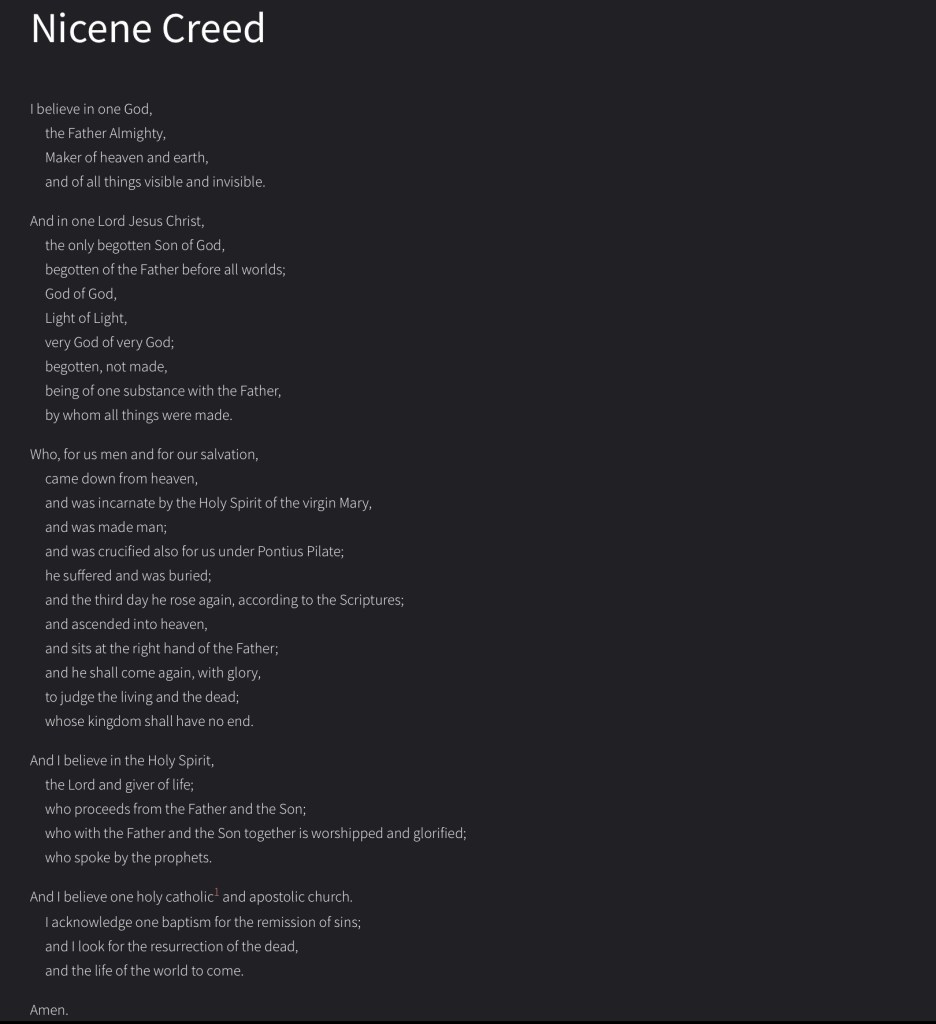
NICENE CREED BASICS
The Nicene Creed was formulated at the Councils of Nicaea (325 AD) and Constantinople (381 AD). It is a foundational statement of Christian faith. It affirms key beliefs about the nature of God, Jesus Christ, the Holy Spirit, and the Church. Here are its highlights:
#1 Belief in One God: Affirms belief in one God, the Father Almighty, creator of heaven and earth, of all that is seen and unseen.
#2 Jesus Christ: Jesus is acknowledged as the only Son of God, begotten from the Father, true God from true God. “Begotten” is a strange word that has caused issues, but was a term chosen because Jesus if God and is not a created being. Jesus has a unique relationship with God the Father. Jesus was incarnate by the Holy Spirit, born of the Virgin Mary, and became human. The creed also emphasizes Jesus’ crucifixion under Pontius Pilate, His death, burial, resurrection on the third day, and ascension into heaven. Importantly it also emphasizes His future return in glory to judge the living and the dead. The creed attempts to put words to the indescribable relationship of the Godhead.
#3 The Holy Spirit: The creed teaches belief in the Holy Spirit, the Lord, the giver of life, who proceeds from the Father (and the Son, in the Western Church tradition). Again, “proceeds” is a difficult word because the Holy Spirit is not an “it,” but God Himself like the Father and the Son. The Spirit is worshiped and glorified with the Father. The creed attempts to put words to the indescribable relationship of the Godhead.
#1-3 above are the basis of trinitarian belief.
#4 The Church: The creed tells us that the gathering of believers is one, holy, catholic (universal), and apostolic Church. Belief in YHWH God, the blood of the Son, and the deposit of the Holy Spirit bond all believers together in the past, present, and future.
#5 Baptism: Even way back when in the early ADs, Christians were baptized into the Kingdom of God for the forgiveness of sins. Notice… one baptism. Water baptism (immersion) + baptism of the Holy Spirit (being born again) = one baptism. Just uno. Sometimes well meaning folks want to separate those, but there is only one baptism in Christ.
#6 Eschatology (thoughts about the end times or eternity): The creed affirms belief in the resurrection of the dead and life everlasting.
NICENE CREED WAS/IS CORRECT TEACHING
We should note that many of the elements we discussed in the last post about the Apostle’s Creed are here with the Nicene Creed. Why? Because regular-normal Christian belief didn’t change. Yet, there was false teachings about which had to be squashed, squished, and discredited. There were teachings about:
#1 Arianism (theological wrongness not the Nazi wrongness) which taught that Jesus Christ was not fully divine, but was a created being making Him subordinate to God the Father. Jehovah’s Witnesses and Mormons still hold on to this one. This is wrong. In the end, pretty much anything with ‘arian’ or something that sounds like it should be avoided.
#1.5 Pneumatomachianism is a related completely wrong thought in that this teaching denied the divinity of the Holy Spirit, claiming that the Spirit was a creation or a lesser being than the Father and the Son.
#2 Docetism claimed that Jesus only appeared to be human and that His physical body was an illusion. Jesus being flesh and blood is an important part of the Incarnation and is important to His physical actual death on the cross. This is wrong. Jesus was flesh and blood. He was a real Boy and not a hologram or Gepetto project.
#3 Adoptionism folks thought that Jesus was born as a mere human and was later “adopted” as the Son of God at His baptism or resurrection. This denies His divinity which is essential to the Incarnation and is important to His acceptance of our sin on the cross. This is wrong. Baby Jesus, some people’s favorite Jesus, was divine at birth. He was always the Son… in Heaven before He arrived and during His whole life and after He ascended.
#4 Modalism proposes God is One Person who manifests in three different modes (Father, Son, and Holy Spirit) rather than being three Distinct Persons in one essence. It sounds really really good. Really. But is still wrong. The Bible is clear they are distinct in ways we cannot understand. There might be some Oneness Pentecostals that have some issues here and probably regularly espouse modalism.
#5 Marcionism followed the teachings of Marcion who rejected the Old Testament and the God of Israel (YHWH), claiming that the God of the Old Testament was distinct from the loving God revealed in Jesus. Also wrong.
Are you getting the idea that it was a melee of false teachings when the Nicene Creed was fashioned? Heresies abounded in their day and it was the job of Church leaders to help believers have a foundation firm in Biblical Christianity.
KEY QUESTIONS
Do you believe any of the above teachings?
Where can these teachings be seen today in and out of the Church?
Is there anything in the Nicene Creed with which you do not agree?
What section of the creed should you study further?
TMB

 Dwelling In Scripture