
The Augsburg Confession (1530)
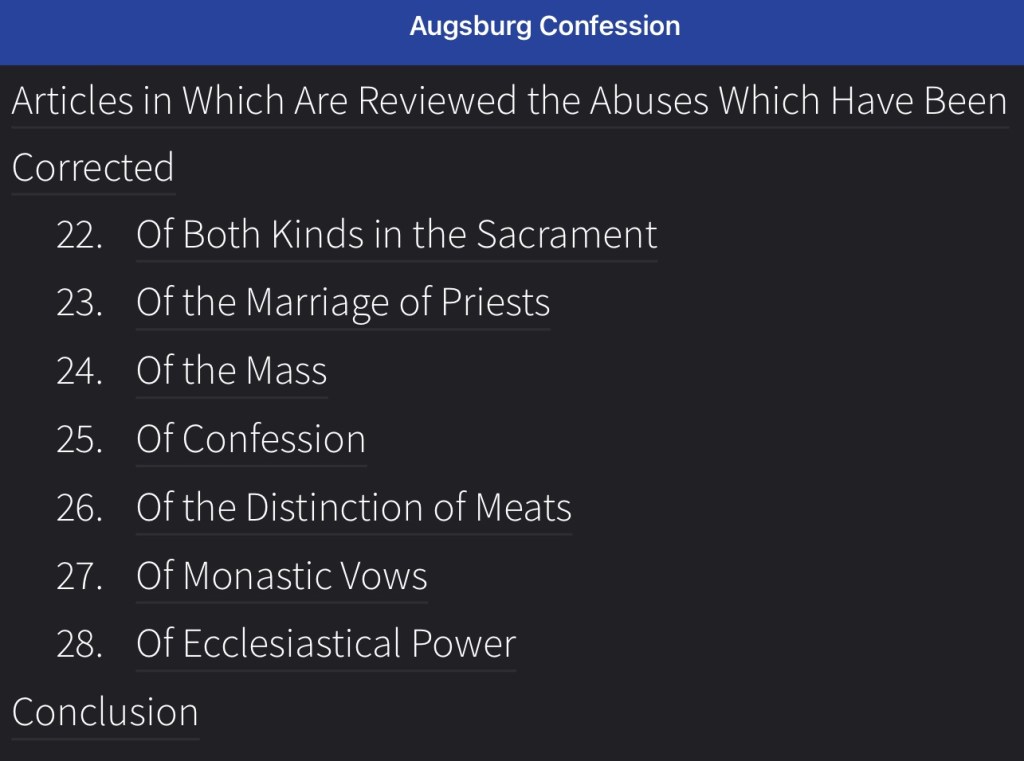
The Augsburg Confession (1530) is a foundational document of the Lutheran Church that outlines its core beliefs. The section that grabbed my attention as I read was the last section which focused on various practices and reforms within the Church. It made me appreciate how much the reformers laid on the line to reform the Church and move Christendom in what I would consider a Godly direction.
They had to purposely state their objections and begin new practices on a large scale. Their reforms and protests of the Roman Catholic Church echo throughout the Church even now.
SIDE QUESTIONS:
I wonder what Martin Luther would think of gay and lesbian clergy?
I wonder what theses about entertainment in the Church he would nail to a door these days?
I wonder how Luther himself dealt with being a celebrity pastor as we are seeing the downside of such notoriety in our culture?
Articles 22-28 Summary
Article 22: The Lord’s Supper. The cup (wine) in the Lord’s Supper should be offered to the laity, not just the bread. Both elements are to be taken by folks in the pews. This restriction is understandable from the Catholic perspective if one believes the wine actually becomes the blood of Jesus (transubstantiation). Nobody disrespects the blood of Jesus. Yet, the reform aligns with Christ’s command to “drink all of it” and restores the original institution of the sacrament for all believers.
Article 23: The Marriage of Priests. Priests are allowed to marry. Mrs. Martin Luther is appreciative of this especially given that she had been a nun. The confession explains that marriage is a divine institution, and Scripture does not prohibit clergy from marrying. Celibacy has led to abuses and scandals. True in his day as in the postmodern world.
Article 24: The Mass. The primary focus of the Mass (catholic worship service) should be on Christ’s sacrifice for the forgiveness of sins, rather than being a good work to earn merit. Ceremonies and services aimed at strengthening faith were highlighted.
Article 25: Confession. I struggle with this topic because the modern and postmodern Church (evangelicals) mostly ignore confession. Sins stay in the dark and keep power over us. In the confession, the practice of confession is encouraged for the comfort of conscience, but it is no longer a burdensome requirement. Also, no one has to list every single sin or fear if they miss one.
Article 26: The Distinction of Meats. These human traditions, while potentially useful, should not obscure the Gospel or impose burdens on consciences. Fish on Fridays is not a salvation issue.
Article 27: Monastic Vows. Luther believed many who entered monasteries did so under compulsion or misunderstanding. This led to spiritual harm and a reduction in Christian freedom. True worship comes from faith, not works.
Article 28: The Power of Bishops. Bishops have authority in teaching and administering sacraments but not in civil governance. The Church’s power is spiritual, aimed at preaching the Gospel and administering sacraments, not enforcing human traditions or exercising temporal power. This makes me think of Cardinal Richelieu in The Three Musketeers movies. Yes, there are books, but Tim Curry popped into my head.
Conclusion
These articles emphasize the Lutheran commitment to restoring biblical practices, simplifying church life, and clarifying the role of the clergy and sacraments in faith. I like every single one of them. Each of them seeks to restore Biblical faith and practice in the church.
I happen to agree with them all and so I find them valuable. I understand my bias, but the truthfulness of these articles remains.
TMB
 Dwelling In Scripture