My Reading Journey 2025: Confessions of St Augustine
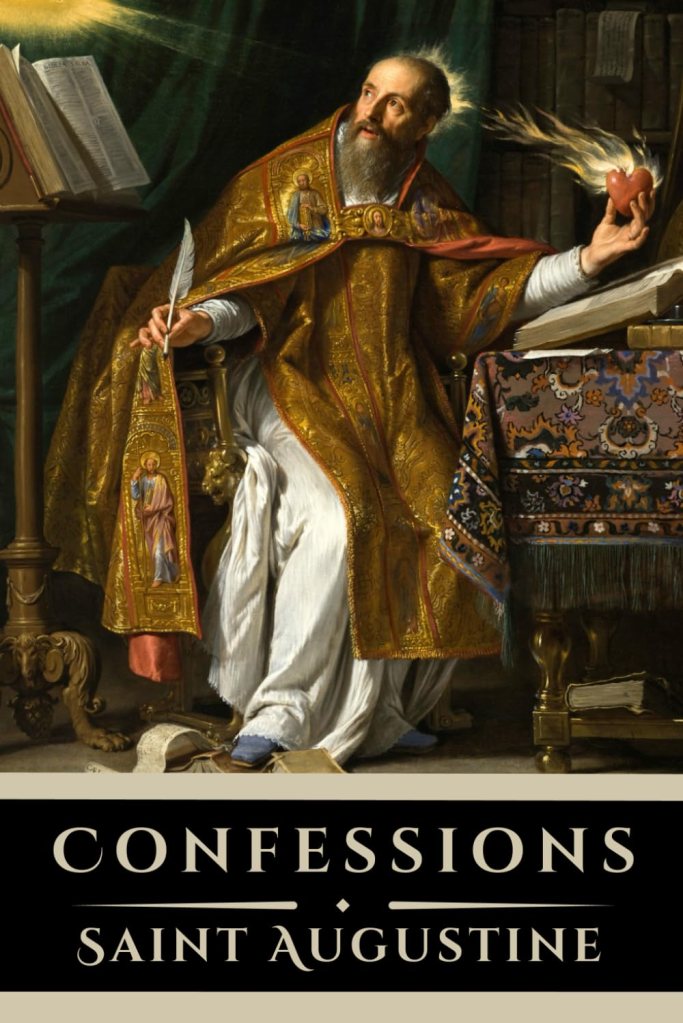
Saint Augustine’s Confessions is a famous work of Christian literature that combines autobiography, theology, and philosophy. Written in 13 books, it chronicles Augustine’s journey from a life of sin and spiritual confusion to his eventual conversion to Christianity.
Books 1-3: Childhood and 20s. Augustine begins with a profound reflection on human dependence on God: “You have made us for Yourself, and our hearts are restless until they rest in You.” He recounts his childhood in North Africa, marked by a thirst for knowledge but also by sin, such as stealing pears with friends for no reason other than the thrill of stealing. At first glance I thought this was a dumb example of childhood sin, but he emphasizes the senselessness and purposelessness of the act so that it comes to represent all of his sin-rebellion against God: “I loved my own undoing. I loved the evil in me—not the thing for which I did the evil, but the evil itself.”
Books 4-5: The Searching 20s. Augustine falls in with Manichaeism as he goes about his education. Manichaeism is a worldview/religion focusing on the central tension of good versus evil in the world. After meeting a much touted teacher of Manichaeism, he was impressed with the character of the man, but not the belief system itself. He decided to pursue truth elsewhere. Enter Bishop Ambrose of Milan who was a profound influence on Augustine to his mother’s delight.
Books 6-8: I used to think that Augustine was sitting one day minding his own business when God spoke to him to read from the Bible and… BAM!… he became a Christian. That’s not totally correct. God placed Ambrose, his mother, the story of St Antony, and several other influences before he read from Romans. I personally do not understand the watershed moment. I think it was a culmination of several things and Romans 13 was the tipping point.
Book 9: Baptism. Augustine had a son through his years of premarital sex and this young man was baptized along with him. Apparently, he was wicked smart and did not hold a grudge that his father was not around him. They were both baptized at the same time. It is interesting (and true) that he states his problems did not go away just because he found true faith in Christ. For some reason, I liked that part. Another good section in Book 9 is the record of the death of his mother. This is definitely a highlight of the book. His prayer to God for his mother is awesome.
Books 10-13: Nonsensical examinations. The last part of the book is Augustine thinking about thinking and philosophizing about time, creation, and other meaningful topics. Augustine wonders why he remembers something and how thinking works. Very strange. It is also in this section that he lays out that YHWH God created everything ex nihilo and affirms this Christian belief. He also defines eternity well as it relates to time itself.
RECOMMENDATION
Confessions remains a timeless work for many Christians and for the life of me I do not see why. I did not find much value in it. I will admit that if there were an abridged version with updated language it probably would be better, but then one drifts from his actual words. The language is unnecessarily complicated, but it also could be that I am simple-minded.
I read it. I don’t see the need to recommend it.
TMB
 Dwelling In Scripture