CREEDS & CONFESSIONS: Athanasian Creed (Part 2)
THE ATHANASIAN CREED
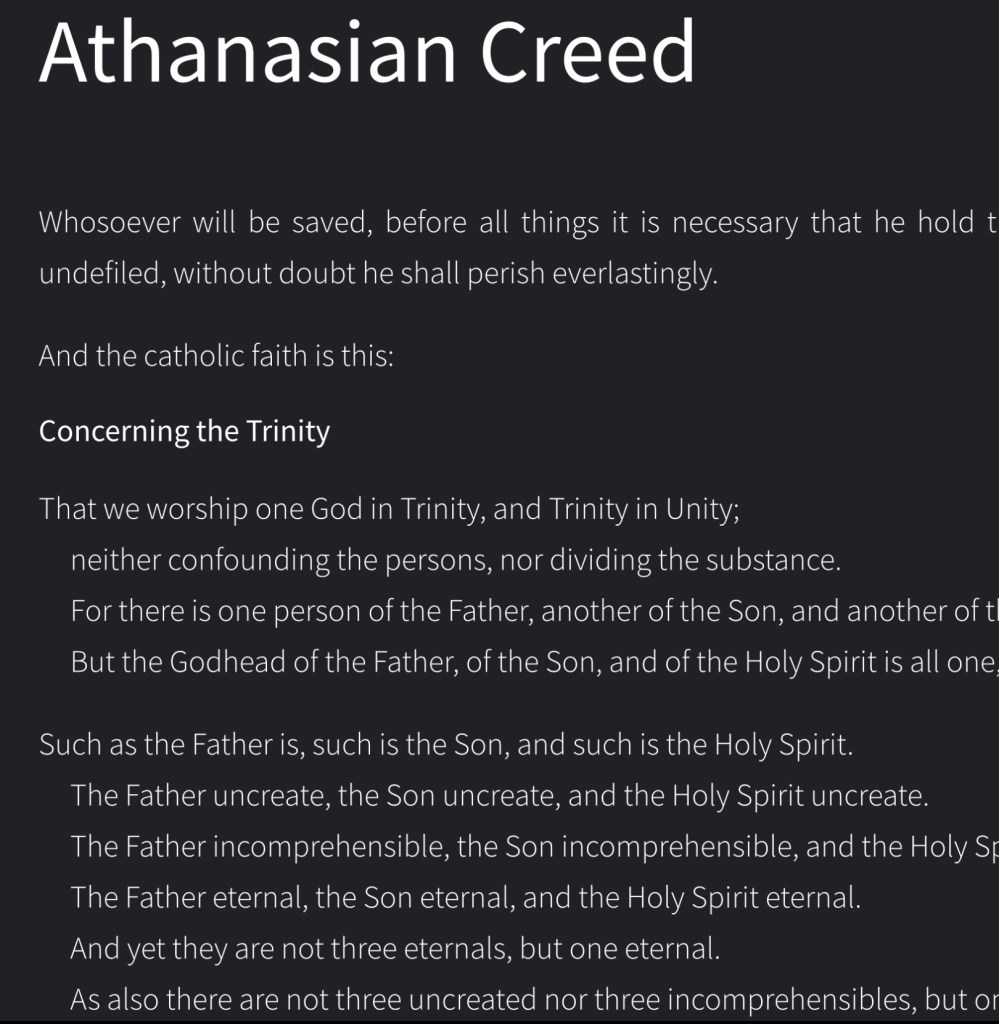
The Athanasian Creed, also known as the Quicunque vult (from its opening words in Latin), is a Christian statement of faith traditionally attributed to Saint Athanasius (ath-ah-nay-shuss) of Alexandria.
There are two key emphases for this creed: Trinitarian Doctrine and the Incarnation of Jesus. For this post (part 2), we’ll focus on the nature of Jesus the Christ. Jesus’ nature is absolutely expressed in the Bible, but it is complicated, theological, and has wide-ranging repercussions which means false teachers have a bullseye on it. Satan wants to distort the image of Christ in the minds of those who might be seeking. A correct view of the nature of Jesus is essential for understanding the Christian faith.
What does the Athanasian Creed teach?
• The creed emphasizes the co-equality and co-eternality of the three Persons of the Trinity: Father, Son, and Holy Spirit.
• It asserts that the Father is God, the Son is God, and the Holy Spirit is God, yet there are not three gods but one God.
• Each Person is distinct but shares the same divine essence.
DEEPER INTO THE ATHANASIAN CREED
Here is a breakdown of the second part of the Athanasian Creed, focusing on the nature of Jesus Christ:
Jesus of Nazareth has two natures as the Christ. Jesus Christ is both fully divine and fully human. In human math this means, 100% human and 100% divine… which doesn’t make sense to us. His divinity is eternal and uncreated, while His humanity is temporal and created. It is confusing. It doesn’t make sense to our finite minds. It is nevertheless, True.
Jesus is God and human at the same time without any of Himself becoming less, mixed, more, or compromised. He is Himself. The creed says: “One altogether, not by confusion of substance, but by unity of Person.” The divine and human natures of Christ are distinct and do not mix or blend into a third kind of nature making Him neither God nor human. They remain fully intact while perfectly united in the one Person of Jesus Christ.
The Creed compares Christ’s two natures to the union of body and soul in a human being. Just as these components make up one person, so Christ’s divine and human natures make up one Person. This is a poor analogy (in my opinion), but it is what we have. It is a poor analogy because a person without a body or a person without a soul is not a human being. Jesus was/is still God before the incarnation. Does your brain hurt? It should. He is simple and complicated at the same time.
Where do we find this in the Bible? John 1. Colossians 2:9. Philippians 2:6-7.
The second part of the Athanasian Creed stresses the uniqueness of the God-Man. It underscores that salvation hinges on His unique personhood and the union of His divine and human natures. The cross is possible and effective because of this hypostatic union (that is the technical term).
If you find a Bible teacher who downplays the humanity of Christ, run away.
If you find a theologian who shys away from the divinity of Christ, run away.
Jesus of Nazareth is both 100%.
TMB
 Dwelling In Scripture